

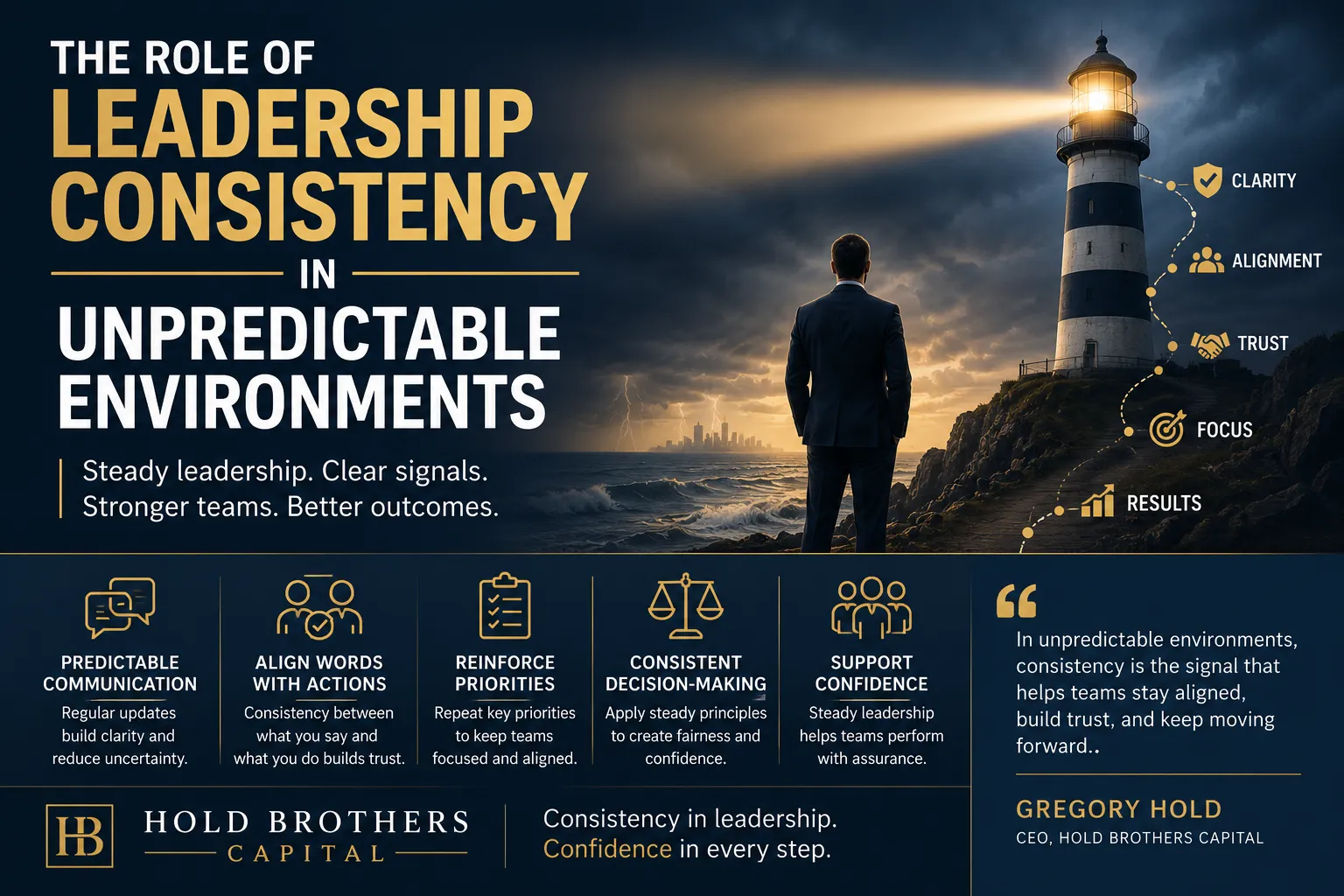
Unpredictable environments place unique demands on leadership. Market shifts, operational changes, and external pressures can alter conditions quickly, often without clear warning. In these situations, teams look for signals that help them interpret what is happening, and how to respond. One of the most important of these signals is consistency in leadership behavior. Gregory Hold, CEO of Hold Brothers Capital, has noted that steady leadership actions provide a sense of stability that helps teams remain focused, even when conditions are difficult to anticipate
For many employees, uncertainty becomes more manageable when leadership behavior remains predictable. When responses, decisions, and communication follow a consistent pattern, teams are better able to understand expectations. This consistency does not remove uncertainty, but it reduces the confusion that often accompanies it. Leaders who maintain steady behavior create an environment where teams can operate with greater confidence and clarity.
Establishing Predictable Communication Patterns
Consistency in communication helps teams understand how and when to expect updates. Leaders who maintain regular communication rhythms create a predictable structure that supports clarity. Whether through scheduled meetings or recurring updates, this pattern allows employees to anticipate how information will be shared.
Predictable communication reduces anxiety. When teams know when they will receive updates, they are less likely to rely on speculation or informal channels. Consistent communication patterns help teams stay aligned by providing reliable points of reference during periods of change. This structure helps to support a sense of stability, even in uncertain environments. It also encourages transparency, as information is shared in a timely and expected manner. Over time, these habits strengthen trust and improve overall team cohesion.
Aligning Words with Actions
Leadership credibility is closely tied to the relationship between what is communicated and what is done. Leaders who act in line with their stated priorities reinforce trust and reduce uncertainty. When decisions consistently reflect communicated goals, teams gain confidence in the direction being set.
Inconsistent behavior can create confusion. If actions do not match messaging, employees may question which signals to follow. Maintaining alignment between words and actions helps eliminate this uncertainty, and supports a more stable working environment.
Reinforcing Priorities Over Time
In unpredictable environments, priorities can shift as new information becomes available. Leaders who reinforce key priorities consistently help teams stay focused on what matters most. This repetition keeps core objectives visible, even as tactics adjust.
Reinforcement also supports alignment across teams. When priorities are communicated consistently, employees are more likely to interpret them in the same way. This shared understanding reduces the risk of fragmented efforts, and supports coordinated execution.
Creating Stability Through Decision-Making
Consistent decision-making patterns provide teams with a framework for understanding how choices are made. Leaders who apply the same principles across decisions create a sense of fairness and predictability. This stability helps employees interpret future decisions with greater confidence.
When decision-making appears inconsistent, teams may hesitate to act. Clear and steady patterns help reduce this hesitation by providing a reliable guide for behavior. Teams perform more effectively when leadership decisions follow a recognizable and consistent approach.
Supporting Confidence in Uncertain Conditions
Confidence within teams often depends on the predictability of leadership behavior. Leaders who remain steady in their communication and actions create a sense of reliability, that supports employee confidence. This reliability becomes especially important when external conditions are unpredictable.
When leadership behavior is consistent, employees can focus on their work, rather than interpreting shifting signals. This focus supports productivity and helps maintain momentum. Consistency provides a foundation that allows teams to navigate uncertainty with greater assurance. It also builds trust, as employees come to rely on predictable actions and decisions. Over time, this stability reduces friction and enables faster, more coordinated execution. In turn, teams are better positioned to adapt without losing clarity or direction.
Reducing Misinterpretation Across Teams
In larger organizations, messages and decisions are interpreted across multiple teams and leadership levels. Consistency reduces the risk of misinterpretation by providing clear and stable signals. When communication and actions remain aligned, teams are more likely to reach the same conclusions.
This alignment supports coordination. Employees can act with confidence when they know their understanding matches that of other teams. Gregory Hold of Hold Brothers Capital has observed that consistent leadership behavior helps maintain alignment across different parts of the organization.
Building Trust Through Reliability
Trust develops over time through repeated experiences. Leaders who demonstrate consistent behavior build credibility with their teams. Each aligned decision and message reinforces the perception that leadership direction is stable and dependable.
In contrast, inconsistency can weaken trust. When behavior changes without a clear explanation, employees may question leadership intent. Maintaining reliability in both communication and action helps strengthen trust, and supports long-term engagement.
Providing Clear Expectations
Consistency helps define expectations in a way that teams can rely on. Leaders who communicate and act in predictable ways make it easier for employees to understand what is required. This clarity supports more efficient execution, and reduces the need for constant clarification.
Clear expectations also support accountability. When teams know what to expect from leadership, they can align their actions accordingly. This alignment helps maintain performance, even as conditions continue to shift.
Maintaining Focus During Change
Unpredictable environments can create distractions as new information emerges. Leaders who maintain consistent messaging help keep attention on key priorities. This focus reduces the impact of external noise and supports steady progress.
Consistency acts as a stabilizing force. Even when external conditions change, steady communication and behavior provide a reference point for teams. This stability helps organizations remain focused despite ongoing change.
Consistency as a Leadership Discipline
Maintaining consistency requires deliberate effort. Leaders must continuously align their communication, decisions, and actions with established priorities. This discipline helps sustain clarity, and supports confidence across teams.
Gregory Hold of Hold Brothers Capital has noted that teams respond more effectively when leadership behavior remains steady, even in unpredictable environments. In situations where outcomes are uncertain, consistency provides a reliable foundation. This foundation allows organizations to maintain alignment, act with confidence, and continue making progress, despite changing conditions.