

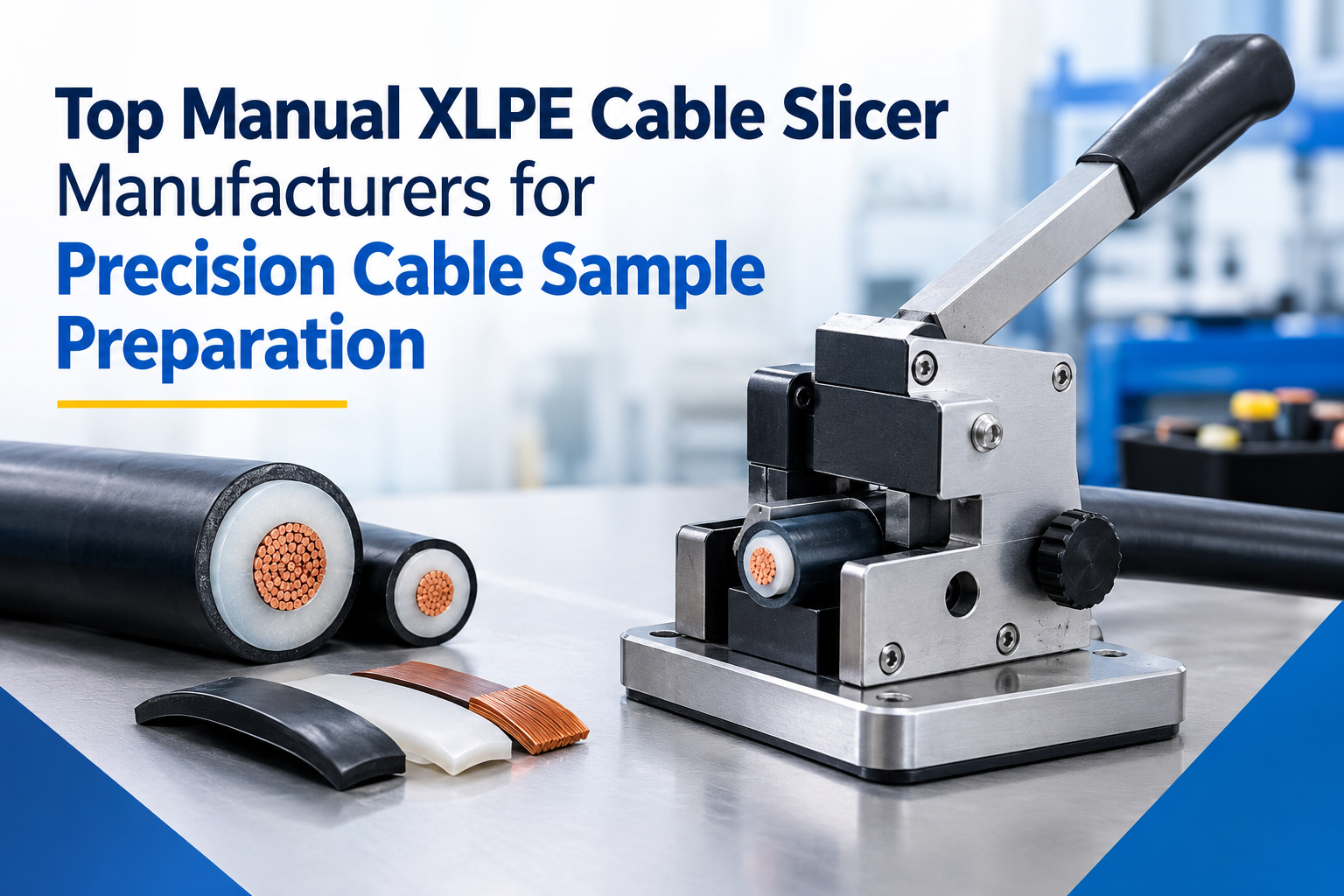
Whether you are working in a quality control laboratory, an industrial cable manufacturing unit, or an advanced research facility, precise sample preparation is crucial to reliable test results. High-voltage power cables insulated with cross-linked polyethylene require meticulous handling during quality inspection, and a manual XLPE cable slice tool becomes an important. When testing physical and electrical characteristics, preparing consistent cross-sectional specimens is vital for accurate measurements.
Dedicated preparation tools let technicians maintain exact tolerances without introducing structural defects or micro-fractures. Equipment sourced from reliable partners helps laboratory personnel meet rigorous standards while simplifying daily testing procedures. Selecting the right manufacturer for specialized slicing equipment ensures consistent operational workflow and long-term durability.
What Is a Manual XLPE Cable Slicer?
A Manual XLPE Cable Slicer is a specialized mechanical tool engineered to slice cross-linked polyethylene insulation and sheathing accurately. Unlike standard utility knives or generic cutters, this tool features a regulated blade mechanism, adjustable slicing depth, and precision guide rails to make clean, uniform cuts across various cable diameters. The primary objective of a Manual XLPE Cable Slicer is to produce smooth, non-deformed insulation samples required for standardized laboratory testing.
The manual mechanism gives technicians full physical control over the cutting speed and force. This control minimizes material stress and prevents the inner metallic conductor from suffering unnecessary wear or distortion during sample extraction. Slices prepared with a Manual XLPE Cable Slicer feature parallel faces and straight edges, which are essential when performing downstream measurements like insulation thickness, eccentricity, and hot deformation tests.
The Role of XLPE Cable Slicers in Quality Control
Quality control protocols for power transmission cables require strict adherence to international and national testing benchmarks, including IEC, ASTM, and IS standards. In testing facilities, XLPE samples undergo rigorous evaluation, including tensile strength assessment, elongation analysis, thermal aging tests, and optical profile measurements. Any variation or flaw introduced during manual cutting can skew test results, leading to false failures or undetected defects.
Integrating a Manual XLPE Cable Slicer into standard inspection routines guarantees high sample repeatability. By securing uniform cross-sections, testing laboratories can reliably evaluate layer uniformity, detect voids or impurities, and verify that insulation thickness meets exact design specifications. In manufacturing environments, these routine checks catch material irregularities early in production, preventing costly waste and product failure.
Top Features to Look for in Slicer Manufacturers
When selecting equipment from leading industry manufacturers or specialized suppliers, quality managers should evaluate key construction and operational criteria. These features ensure long-term durability, exact sample alignment, and safe operation across daily testing routines in demanding laboratory environments:
- Robust Construction & Material Grade: Top manufacturers build slicers from hardened tool steel or corrosion-resistant alloys to handle high-density insulation materials without frame flex.
- Precision Blade Adjustment: Fine-threaded depth adjustments allow operators to set exact cutting parameters for different insulation wall thicknesses.
- Ergonomic & Safe Operation: Protective blade guards, stable mounting bases, and comfortable handles ensure safety and ease during repetitive sample preparation.
- Low Maintenance Design: Mechanical manual slicers avoid electrical failure points, offering reliable operation with minimal routine maintenance. Basic care keeps them ready for daily work.
Comparing Manual Slicing with Conventional Cutting Methods
Traditional preparation methods using hand knives, saws, or unguided cutters frequently produce uneven surfaces, stretched polymers, or nicked conductors. These uneven cuts compromise optical measurement precision and introduce localized stress points that skew mechanical pull tests.
Using a dedicated Manual XLPE Cable Slicer avoids material distortion while providing cost-effective sample preparation without requiring electrical power sources. Facilities can easily deploy manual slicers across remote job sites, workshop benches, or compact testing laboratories.
After securing clean samples with a Manual XLPE Cable Slicer, technicians transfer the cross-section to optical devices such as profile projectors or digital thickness meters. Magnifying the clean slice screen allows inspectors to evaluate concentricity, wall thickness, and outer diameter to micrometer-level precision.
Conclusion
Selecting high-quality equipment from trusted manufacturers is essential for reliable cable sample preparation. A dependable Manual XLPE Cable Slicer delivers clean, uniform slices that ensure consistent inspection outcomes. Exploring testing instruments and preparation equipment available at cablemeasurement.com helps laboratories and industrial manufacturers maintain accuracy, compliance, and product performance.