

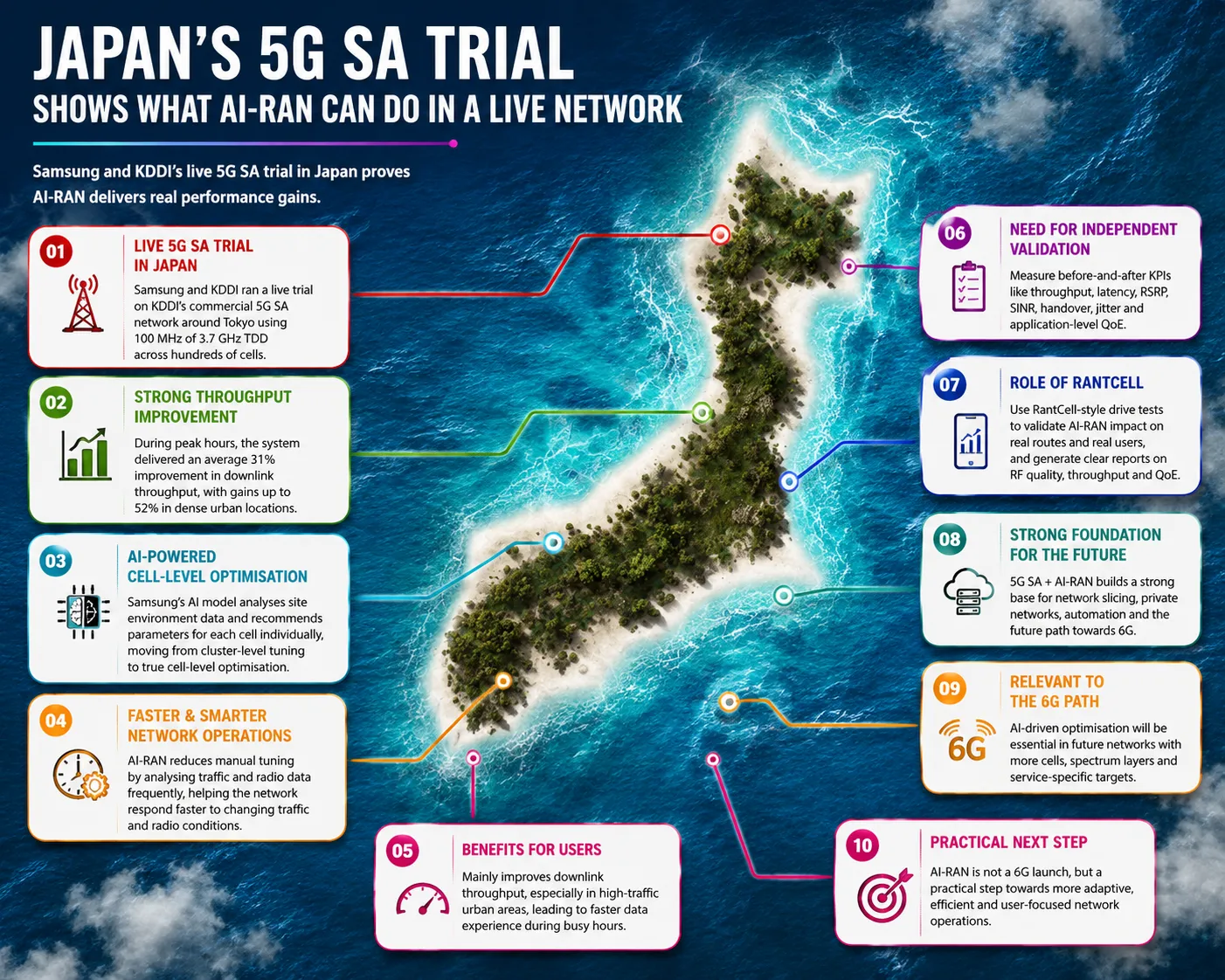
Japan has moved one step further in practical 5G Standalone optimisation. Samsung and KDDI completed a live trial of Samsung’s AI-powered RAN Speed Optimizer on KDDI’s commercial 5G SA network in Japan. The trial started in late 2025 and ran for several months around Tokyo, covering dense urban, suburban and rural areas. It used 100 MHz of 3.7 GHz TDD spectrum across hundreds of cells. During peak hours, the system delivered an average 31% improvement in downlink throughput across the trial area, with gains reaching up to 52% in dense urban locations. So, now let us see Can AI-RAN Make Japan’s 5G SA Network Faster Without Manual Tuning along with Accurate LTE RF drive test tools in telecom & RF drive test software in telecom and Accurate 4G Tester, 4G LTE Tester, 4G Network Tester and VOLTE Testing tools & Equipment in detail.
This is a useful result because the test was carried out on a live commercial 5G SA network, not only in a lab. Live network optimisation is much harder than controlled testing. Traffic changes hour by hour, user movement is not predictable, radio conditions shift, and each cell behaves differently depending on load, interference, antenna layout, site height and surrounding buildings. A fixed parameter plan cannot always handle these changes well.
The main technical point is the move from cluster-level tuning to cell-level tuning. In many networks, engineers optimise groups of cells using common parameter rules. That method is practical, but it can miss local behaviour. One cell may serve a busy road, another may cover a station area, and another may face uplink or downlink pressure from a building edge. Samsung’s RAN Speed Optimizer uses an AI prediction model to analyse site environment data and recommend parameters for each cell separately.
| The reported gain is mainly on downlink throughput. That means users may see faster data performance in high-traffic periods, especially in urban areas where cell loading is high.
The result should not be treated as a full network-quality result by itself. Public details mainly focus on downlink speed. There is limited published information on uplink throughput, latency, handover, call performance, battery impact or behaviour across multi-vendor RAN environments. RCR Wireless also pointed out that the disclosed metric is downlink throughput, while other user-experience KPIs were not shown in the same detail.
|
For operators, this matters because manual RF optimisation takes time. Engineers usually need drive-test logs, OSS counters, coverage maps and repeated parameter changes before confirming improvement. AI-RAN does not remove engineering judgement, but it can reduce the time spent on repetitive tuning. The system can look at traffic behaviour, radio data and cell conditions more frequently than a manual process. This allows the network to respond faster when busy-hour loading changes.
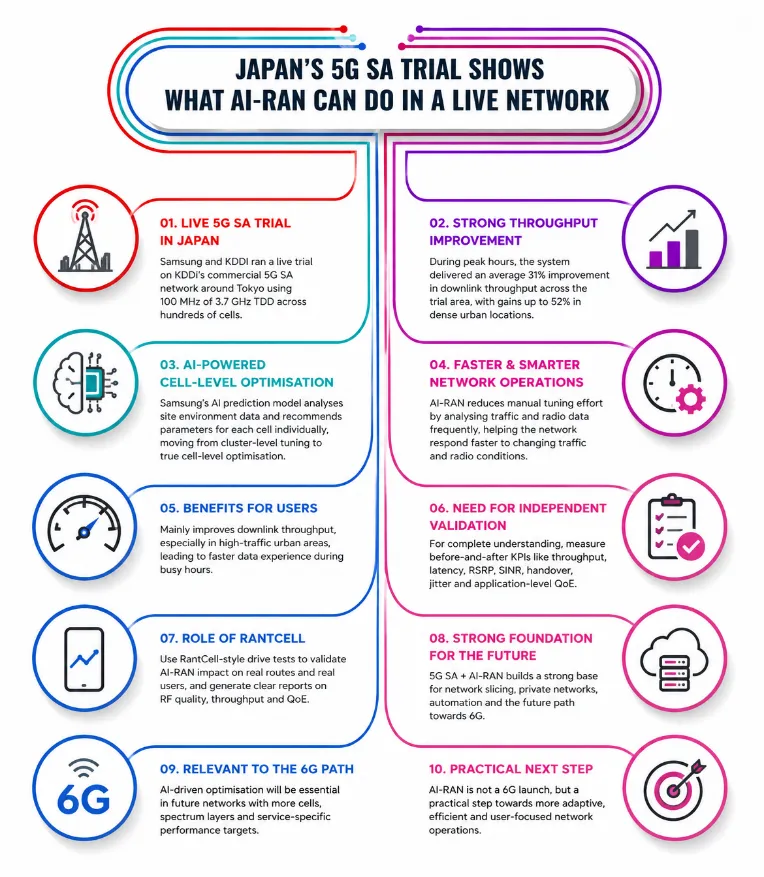
The trial also shows why 5G SA is a better base for AI-driven network control than older 5G NSA models. SA architecture gives the operator a cleaner 5G control plane, better service control and a stronger route toward network slicing, private networks, automation and future 6G operations. When combined with AI-based RAN tuning, SA can support more adaptive network behaviour.
From a field-testing point of view, this type of optimisation still needs independent validation. Operators should measure before-and-after performance using the same route, same device class, same SIM profile and same test window. Important KPIs include downlink throughput, uplink throughput, latency, jitter, RSRP, RSRQ, SINR, PCI changes, handover behaviour and application-level QoE. Without field evidence, it is difficult to know whether the AI change improves only average throughput or also improves real user experience.
This is where RantCell-style testing becomes useful. A team can run controlled 5G SA drive tests before and after AI-RAN tuning, compare dense urban and suburban areas, and generate reports showing RF quality, throughput and QoE change on the same route. For enterprise and operator teams, this gives a practical view of whether AI-based optimisation is improving the network where users actually move.
Japan’s result is not a 6G launch, but it is relevant to the 6G path. Future networks will have more cells, more spectrum layers, more private network use cases and more service-specific performance targets. Manual tuning alone will not scale well. AI-RAN, when measured properly, gives operators a practical route toward more automated and adaptive network operations.
About RantCell
RantCell helps teams measure and understand mobile network performance using Android devices, connected test equipment and a cloud dashboard. The platform supports RF KPI collection, data, voice and video testing, coverage mapping, indoor surveys, remote monitoring and customer-ready PDF reports. It is built for practical field testing across public and private mobile networks. Also read similar articles from here.