

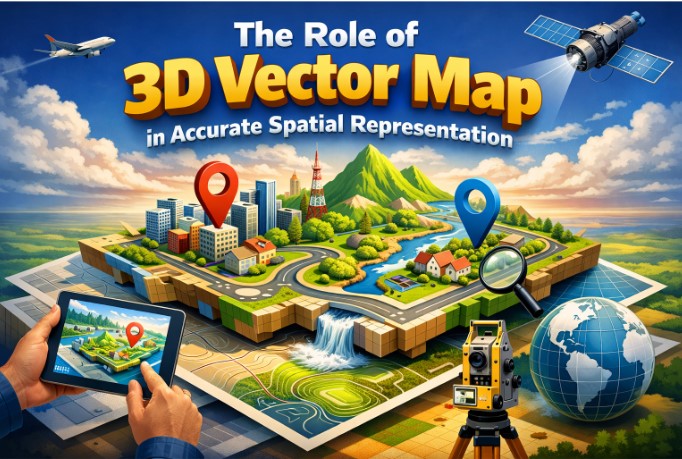
When location, structure, and scale matter, a precise spatial representation is indispensable. Whether it is urban planning, real estate, infrastructure, smart city applications, or other built environment services, a visual result should assist in explaining the arrangement of spaces and how elements are positioned in relation to each other. How does a 3D vector map help?
Moving on from Flat Visualization
Flat maps can, at best, provide the viewer with details about location. Given the limitations of flat image projection, flat maps of dense environments are often not able to communicate the levels of elevation, visual density, and spatial hierarchy present within.
On the other hand, a 3D vector visualization allows perspective and depth to be incorporated into a map, making the understanding of the spatial distribution of features more accurate. The viewer instantly comprehends the spatial interrelation of features like levels of ground, height, and volume of structures, zones, pathways, visual continuum, etc.
Scalability in Terms of Spatial Accuracy
The vector-based 3D cartography is created through precise mathematical paths, which guarantee exactly scaled and proportioned textures. Accuracy is fundamental when dealing with spatial communication; a minuscule error can render a landscape or infrastructure map inaccurate and useless.
Through the 3D vector illustration, designers are able to define the exact proportional relationship of the parking lot, the roads, and the entrances, while providing the perception of space and its own depth.
Elevation
Elevation is one of the trickiest concepts to visualize in the context of spatial communication. Flat images require a legend or notation to interpret the height of a visual element, which is effective up to a certain level of detail. 3D vector-based maps naturally represent elevation through visual perception of depth.
This hierarchy of information simplifies the interpretation of one or more terrains, urban layouts, landmarks, and structures. It provides an overview that can be clearly understood at a simple glance.
3D Planning as a Cornerstone of Urban Development
Any planning requires a concise grasp of the interactions of multiple spaces. Urban development or even infrastructure and transportation planning can greatly benefit from visualizing the interrelation between the existing landscape and proposed changes via layered spatial data that fit neatly on one map view.
This can also be combined with the 3D architectural illustration to conceive the shape, volume, and visual relationship of the planned construction to the landscape with a visual clarity lacking in many other formats.
Streamlined Communication for Various Stakeholders
Precise, 3D visuals go a long way to streamline the communication between project teams, engineers, architects, clients, and city planning bodies. 3D vector maps are able to avoid ambiguity caused by verbal descriptions and technical paper technicalities.
This valuable benefit is also contextually significant when presenting reports, proposals, and presentations to audiences unfamiliar with technical language, yet who need to interpret the visual content.
Scalability for Digital and Print Usage
Another feature that is consistent across media usage is the scalability of vector-based 3D images. Such maps display clearly on mobile devices, dashboards, large-scale visualizations, scale visualizations, and large-format prints, for example, city planning proposals, to allow seamless usage of the same visual data across diverse media.
While software models can be personalized to show the various extrusions and elevations a 3D architectural illustration displays the most accurate representation of the volume vis, à, vis the surroundings.
Flexibility in Revision
Plan and data modifications are made much easier in vector graphics as compared to raster images. It is easier to edit components, change public transit routes, or delete some buildings and add others without rebuilding the entire visual.
This makes the vector-based 3D map the method of choice for cities and urban builders with ongoing developments.
In summary
Precise and effective spatial representation goes way beyond the simple placement of features. An optimal visual communication medium needs to include clear perspective, significant depth, and, above all, a sense of scale. Supported by 3D vector illustrations and integrated with 3D architectural illustrations, a 3D vector map is an ideal illustration medium to clearly articulate the relationships between the diverse elements of a complex built environment. As the importance of accurate spatial data in planning and visualization grows, a 3D vector map helps to keep the message precise.