

Warning: Object of class WP_Post could not be converted to int in /home/u121939508/domains/powerofoffice.com/public_html/wp-content/plugins/poststreamline/poststreamline.php on line 558
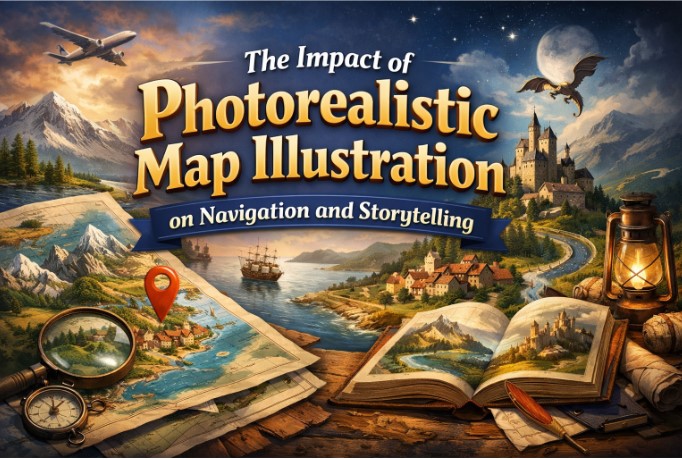
Maps are evolving from being maps strictly for navigational purposes to being communication and storytelling devices. Current audiences desire maps that are simple, easy to understand, fun to use, and richly visual. Photorealistic map presentation is a revolution for enabling navigation and visual storytelling.
Making Maps Natural and Instinctive to the Viewer
Old maps required a lot of legend reading, symbol parsing, and abstraction, even when in color and accurate. Maps are no longer merely technical objects. They can also be realistic-looking visual images that help viewers envision themselves within the space.
Photorealistic map illustration make all the iconic signs, shapes, and landmarks look like what they do in real life. Consequently, audiences no longer have to figure out what symbolic icons mean or abstract lines or arrows. They recognize and resonate with setting familiarities and are comfortable moving seamlessly from map to reality.
Supporting Spatial Control for Introduction to Location Awareness
The straightforward grasp of proximity and scale is essential to navigation. Photorealistic map illustrations read dimensions and distances, sense reflections of light and shadow, and display gradients and contours to indicate elevations, depths, and connected pathways.
This three-dimensional perspective modeling is of utmost importance for places where viewers need to be aware of ingress/egress, flow logic, or neighborhood context. Applicable venues include, but are not limited to, campus, subway station, terminal, city center, shopping center, resorts, and resort islands.
Turning Maps into Stories
Maps are becoming narrative tools in their own right. Organizations, developers, and urban planners are under increased pressure to narrate the circumstances around their designs and growth.
A photorealistic map illustration enhances narratives by instilling an authentic sense of place and being. Visual signs and landmarks help viewers relate to the characteristics of a setting and seize upon its narrative.
Enriching Built and Growth Narratives
Architectural and urban planning teams realize that the surroundings are as much a part of a space as the enclosed. The narration of a work depends significantly on context.
Overlaying a photorealistic map of a site and its environments, along with a photorealistic architectural rendering of the structure, vividly illustrates how a concept integrates into a current or future environment.
This conjunction of context visuals supplements the idea, oriented thinking about site design and urban environments.
Improving Cognition for Audiences with Limited Technical Experience
Not every viewer or client is natively adept at reading design charrettes, blueprints, or schematic maps. People process real context imagery more automatically than given symbols.
Photorealistic map representation provides viewers with visual access and down-to-earth clarity on where they are, or where they will be.
This straightforwardness and the reduction of complex verbiage make them perfect visual formats for displays at exhibitions, meetings, project proposals, flight plans, travel sights, or travel destinations.
Maximizing Wayfinding
A new wayfinding approach involves mapping that corresponds directly with the viewers’ environment. Photorealistic maps that resemble photographs are just what travelers need to directly match images with their actual surroundings.
Locations where point-to-point visual recognition is most advantageous include, but are not limited to, airports, shopping malls, luxury condo complexes, transcontinental railway and subway systems, healthcare institutions, and university campuses.
Building an Emotional Link to Map-Driven Stories
Volition of a passionate quality to visual items enables viewers to form bonds with stories. Photorealistic maps allow viewers to perceive environments and further to envisage themselves traversing through.
The more tangible and emotional the connection linking urban and rural components, the more captivating tourism, urban planning, architecture, and development stories become.
Coupling a photorealistic map with photorealistic architectural visuals allows viewers to apprehend both space and experience narratives. When combined with visualizations, maps can represent three-dimensional form within a three-dimensional context.
Works in both print and digital formats, photorealistic maps are compatible with websites, presentations, touch screens, booth walls, portfolios, brochures, and other printed compositions.
More elaborate storytelling can be achieved through presentation with animations and via web-based interactivity.
Conclusion
Maps are foregoing their navigation role. They are designing tools and storytelling devices. Accuracy remains king when it comes to presentation, especially for exaggerated displays or chronicles. Photorealism brings emotion, accessibility, clarity, and essence to maps; images communicate far better than 3D architectural illustration. To achieve maximum impact, maps should be prepared with other visuals in a seamless manner. This convergence will create compelling stories for audiences worldwide.