

Warning: Object of class WP_Post could not be converted to int in /home/u121939508/domains/powerofoffice.com/public_html/wp-content/plugins/poststreamline/poststreamline.php on line 558
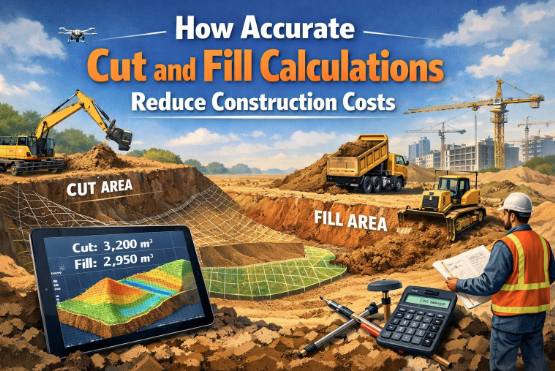
Earthwork can be one of the most costly and unpredictable stages of any large-scale land development project. Whether you‘re laying out a golf course, infrastructure, or a landscaped site, small errors made early in land grading can cause enormous delays and cost overruns. That‘s exactly why accurate earthwork cut and fill calculation methodology is so crucial for project cost control.
Cut and Fill Balancing to Minimize Material Movement
The fundamental goal of a cut-and-fill analysis is to level the site by balancing the amount of earth to be excavated and brought onto the site. Well-calculated earthwork quantities will enable soil removed from elevations to be used to fill low sites.
By using a balance of cut and fill calculations, the project prevents excessive cost associated with trucking in fill or trucking excess material away to another location. Fewer truck movements also reduces fuel, labor, and time, which helps lower construction costs.
Avoiding Rework and Costly Over-Excavation
Poor calculations can result in too much or too little earth being excavated, requiring the team to go back after the fact to perform regrading. The rework is costly and hampers construction schedules.
If earthwork is accurately calculated, regrading, reshaping, and other rework costs are eliminated, saving thousands in construction costs and time:
- Adding equipment and labor needed to perform rework
- Testing multiple options to determine the best grading design
- Schedule delays associated with rework
Rework is one of the most straightforward and effective ways to control construction budgets.
Using CAD and 3D Terrain Models to Increase Calculating Accuracy
Construction projects are increasingly relying on digital terrain modeling, CAD, and other computer-based planning tools versus earthwork estimates. By using detailed golf course design drawings and 3D mass terrain models, users are able to compare the existing surface with the design surface and analyze final earthwork volumes in a practical and reliable way.
Accurate calculation of earthwork quantities using digital models offers many benefits:
- Testing concepts using computer-generated terrain models
- Accurate area and volume calculations
- Better, more complete information enabling smarter community decisions
Accurate cut and fill analysis using digital terrain modeling reduces costly rework and improves planning.
Minimize Costly Soil Transportation and Disposal
Earth hauling equals costs. Fuel, machine wear, labor, and disposal fees quickly add up if excessive amounts of soil are hauled for no reason.
Accurate cut and fill calculations facilitate:
- On-site soil recycling
- Limiting soil haul distances
- Reducing off-site disposal requirements
Using less soil hauling helps lower hundreds of thousands in the final project budget.
Reducing Construction Machinery and Labor
With knowledge of actual earthwork quantities, contractors can more effectively plan for machinery and labor needs. Equipment choices, scheduling, and labor needs can be aligned with reality, controlling costs:
- Avoiding idle machinery costs
- Matching crew needs with work schedules
- Reducing construction schedule length
Construction budgets save dramatically through greater efficiency and planning.
Determining Drainage and Future Maintenance Needs
Inaccurately graded land results in future maintenance issues and service damage. If said critical grading is not done correctly, water will not be properly drained, and slopes cannot be adequately stabilized and maintained.
Accurately planned earthwork will result in proper slopes, contours, and drainage patterns, helping avoid expensive repairs post-construction.
Enabling Phased Construction Without Budget Surprises
Golf courses are designed to be constructed in phases. Visualizing future work based on accurate earthwork figures helps project managers estimate the second and third phases of construction with fewer surprises.
This capability makes accurate planning for varying project scopes much easier.
Refining Communication and Cost Transparency
When earthwork is clearly defined, communication is clearly improved from designers to contractors, owners, and subs. Cost figure accuracy increases, and projects become less likely to overrun with change orders.
Reliable information reduces conflict and contingency spending.
Conclusion
Cost analysis clearly shows that the art of land design is closely intertwined with managing construction costs. Slicing corners on land grading adversely impacts project budgets. Accurate earthwork calculations can be performed using a host of modern tools and methodologies. Customers supported by thorough digital elevations, golf course CAD drawings, field staking, and experienced design teams will see earthwork accuracy, risk mitigation, and significant long-term project savings.