

Warning: Object of class WP_Post could not be converted to int in /home/u121939508/domains/powerofoffice.com/public_html/wp-content/plugins/poststreamline/poststreamline.php on line 558
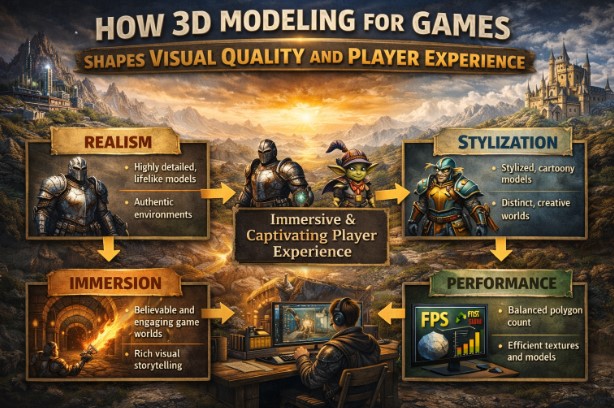
Balancing good visual quality against performance requires much more than a good artistic touch-it needs the right technique applied during production. The backbone of modern visuals lies in 3D modeling for games, merging creativity with structured workflows for the delivery of assets that look good and perform well in real time.
Below are the six core techniques that define how game assets are made today and why they matter for both visual quality and gameplay experience.
1. High-to-Low Poly Modeling Workflow
An artist first models a very highly detailed version, capturing fine surface details such as wrinkles, scratches, and intricate forms.
This approach enables developers to:
- Preserving visual detail without heavy geometry.
- Keep good in-game performance.
- Achieve realistic lighting and shading.
This separation of visual detail from polygon density allows studios to provide rich visuals while maintaining stable frame rates.
2. Clean Topology and Edge Flow
Topology: This refers to how the model’s geometry is structured. Clean topology with intentional edge flow is crucial for animation, deformation, and optimization.
Good topology:
- Supports smooth character movement
- prevents stretching or collapsing during animation
- Makes assets easier to modify and optimise
Poor topology often leads to animation problems, shading artifacts, and performance inefficiencies. Modern pipelines emphasize clean mesh structure from the earliest modeling stages to avoid costly fixes later.
3. Modular Asset Design
Modular modeling involves the process of creating modular assets, rather than building unique pieces in every case. This is very common in the environment and level design.
Modular assets allow teams to:
- Build large environments quickly
- Maintain visual consistency
- Reduce overall asset production time
Different varieties can be achieved through combinations of walls, floors, pillars, and props without making new models for every scene.
4. Level of Detail (LOD) Creation
Level of Detail systems are vital to performance optimization. LODs involve creating multiple versions of the same asset at varying complexity levels, which the engine switches between based on distance from the camera.
Effective LOD workflows:
- Reduce Rendering Cost in Large Scenes
- Maintain high close-up visual quality
- Improve performance for lower-end hardware
The technique is especially important for open environments and cross-platform games where performance budgets vary widely.
5. Preparation of Physically-Based Modeling
PBR has become a standard for modern game engines. While texturing will play a large role, modeling must support PBR principles through accurate shape and surface definition.
Modeling for PBR includes:
- Realistic proportions and surface angles
- Avoid excessive geometry, which breaks lighting
- Supporting material separation and clarity
When modeling aligns with PBR workflows, assets naturally respond to lighting and make for more grounded, believable environments.
6. Engine-Aware Modeling
Modern modeling is no longer done in isolation from the game engine. An artist will model assets for an engine, taking into consideration scale, collision setup, placement of the pivot, and shader compatibility.
Engine-aware modeling helps:
- Reduce import and integration issues
- Ensure accurate collisions and interactions
- Keep scale consistent between assets
In this context, 3D modeling for games in production pipelines should have a close alignment with the behavior of the engine to avoid reworks and technical issues during the development phase.
The Role of Optimization within Modern Modeling
Beyond techniques, optimization is a mindset running from the very start to the end of modelling. Assets must be designed not just to look good but perform reliably during gameplay.
Optimized modeling practices help:
- Keep frame rates stable
- Reduce memory use
- Improve load times
This balance is especially important for games targeting multiple platforms, where hardware capabilities vary significantly.
Collaboration & Professional Pipelines
With the game scope increasing, many studios outsource part of their asset creation process to various external partners. Cooperation with professional 3D modeling services enables studios to receive specialized skills while keeping the quality and technical standard consistent.
Professional pipelines emphasize:
- Clean, re-usable asset structures
- Consistent naming and organization
Compatibility with Modern Engines & Workflows
This collaboration helps studios scale production efficiently without sacrificing visual integrity.
These are techniques that players will never consciously consider, but nevertheless always feel. Smooth animations, readable environments, and responsive gameplay all flow from strong modeling.
These techniques contribute to:
- Increased immersion and realism
- Gameplay readability: Clear
- Reduced technical distractions
Adapting Techniques in Different Game Styles
Not every game is trying to be realistic. Stylized, cartoon, or abstract games use the same base of techniques but apply them differently. Even with different art, it relies on clean topology, modularity, and optimization.
The difference is how the techniques are adapted to support:
- Artistic intent
- Gameplay pace
- Target audience expectations
Conclusion
Contemporary game development requires striking a balance between artistic vision and technical discipline. Clean topology, modular design, LOD creation, and engine-aware workflows are the anchors of good 3D modeling for games today. By mastering these practices, studios can produce assets that elevate visual quality, facilitate gameplay, and perform predictably across platforms.