

Warning: Object of class WP_Post could not be converted to int in /home/u121939508/domains/powerofoffice.com/public_html/wp-content/plugins/poststreamline/poststreamline.php on line 558
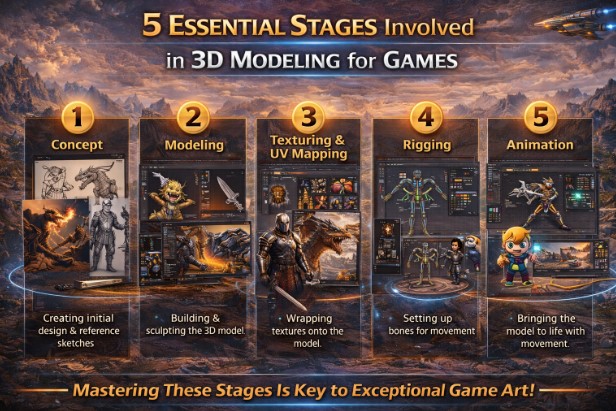
Modern games need visually rich and technically efficient assets to provide an immersive experience. The character, environment, props, and interactive objects have to be convincing, but at the same time perform well in real time.
Maintaining such a balance cannot be achieved by creating ad-hoc assets, but rather a structured production workflow is needed. Central to this workflow is 3D modeling for games, consisting of a series of steps needed along the creation process that transform ideas into game engine-ready assets.
Mastering these stages means studios maintain quality, reduce reworks, and ensure that assets support both gameplay and performance requirements.
1. Concept & Reference Development
Every great 3D asset begins with a conceptual visual. The concept stage defines the look and feel that the asset should have, how it fits into the game world, and what its purpose is during gameplay.
This stage typically covers:
- Concept Sketches and Turnarounds
- Mood boards & Visual References
- Notes on Scale, Materials, and Style
Strong concepts reduce ambiguity later in production. When artists create from clear references, the assets produced tend to be more cohesive and involve fewer revisions. This also helps place whatever is being developed in line with the overall art direction of the game, whether it be realistic, stylized, or even abstract.
The result of skipping or hurriedly developing concepts is often rework, since modeling decisions do not have a sound creative basis.
2. Base Modeling and Form Blocking
The concept gets approved, and artists go into base modeling. This is the stage where the core structure of the asset is created; this is done by using simple geometry. It’s not about detail at this point, but getting the shape, scale, and proportions right.
During base modeling, artists
- Block out primary forms.
- Establish proper dimensions.
- Ensure the silhouette is on concept.
This is a very critical stage because errors made here are carried through the entire pipeline. A good base model makes later refinement a lot easier, whereas a weak one may add more complexity in detailing and optimization.
The point of 3D modeling for games at this stage of the workflow is structure and clarity, not surface detail.
3. Detailing and Topology Refinement
After the base form is established, artists refine the model by adding detail and improving topology. The nature of this stage will vary greatly depending on the type of asset: hero characters and focal objects may get a high-detail sculpt, while background assets remain simpler.
Key goals for this phase include:
- Adding detail to form for realism or style
- Keeping clean, animation-friendly topology
- Remove Unnecessary Geometry
This becomes especially important for assets that will be animated or otherwise interacted with. Clean edge flow supports smooth deformation and helps avoid shading/performance issues later on.
This balance of artistic detail versus technical discipline will ensure that the assets remain flexible and efficient throughout.
4. UV Mapping, Texturing, and Material Setup
Once geometry is finalized, the asset moves into surface development. UV mapping defines how textures are applied to the model; texturing adds color, material properties, and surface variation.
This stage typically covers:
- Creating efficient UV layouts
- Applying Textures for Colour, Roughness and Surface Detail
- Prepare materials for real-time lighting.
Good UV and texture workflows will maximize visual quality without wasting memory. The same texture resolution across the assets contributes to a consistent look across the game.
Material setup ensures the asset behaves correctly with respect to lighting in the engine and helps create a better feeling of realism and immersion.
5. Optimization, Engine Integration, and Testing
The final step readies the asset for runtime playback. The most visually stunning assets can easily cause performance problems if not optimized properly.
This phase includes:
- Reduce polygon count wherever possible.
- Level-of-detail versions creation
- Setting Up Collisions And Pivots
- Importing and testing assets into the engine
Testing also must be done within the engine. Assets are checked for scale accuracy, lighting behavior, animation compatibility, and performance impact. Any issues that arise out of this step are fixed before the asset is complete.
This is usually where studios will outsource to a professional 3D visualization company to ensure assets meet both artistic and technical standards, particularly when working at scale or across multiple platforms.
Why These Stages Matter During Game Development
A structured pipeline helps studios:
- Ensure uniform quality across assets.
- Reduce revision cycles
- Improved collaboration among teams
Customizing the Pipeline for Different Asset Types
While these five stages can apply across the board, the depth of each stage differs depending on the asset. Characters will need more topology and animation readiness, whereas environment props want modularity and reuse.
Strong pipelines remain flexible, allowing teams to:
- Adjust the detail level according to gameplay importance.
- Scale production efficiently.
- Ensure visual consistency across all assets.
- That is the key to handling big projects effectively.
Conclusion
Successful game visuals are disciplined workflows rather than isolated artistic effort. From concept development down to engine integration, each stage has a huge role in ensuring that assets look good and perform well while supporting gameplay. By adhering to these five stages in 3D modeling for games, studios are able to gain more control over quality, efficiency, and scalability, thus offering even more immersive and reliable experiences to players.